
Why You're Not Losing Weight — Even When You're Doing Everything Right
It wasn't something I was taught at university.
Nutrition degrees cover a lot of ground — macronutrients, micronutrients, disease states, dietary guidelines — but insulin resistance wasn't something that got much airtime when I was training. So when clients started telling me, with genuine frustration and complete sincerity, that they honestly weren't eating that much and still couldn't lose weight — or that they'd just look at a piece of cake and put on weight — I didn't have a good answer.
So I went looking for one.
What I found changed how I work with almost every client I see.
What insulin resistance actually is…
Insulin is a hormone produced by the pancreas. Its job is to act like a key — unlocking your cells so glucose, which your body breaks down most of the food you eat into, can get inside the cells and be used for energy. When the system works well, blood sugar rises after eating, insulin is released, glucose moves into the cells, blood sugar comes back down.
Insulin resistance is when the cells stop responding to that key properly. The pancreas compensates by producing more insulin — sometimes a lot more — to get the same result. For a while not much changes, but as insulin levels become chronically high there are consequences, and one of the most significant is that it turns up fat storage and turns down fat burning.
This is why someone with insulin resistance can be eating carefully — genuinely carefully — and still struggle to lose weight. The problem isn't calories in versus calories out. It's that the metabolic environment has shifted in a way that makes fat loss not as easy.
What drives it
Several things contribute to insulin resistance. A diet high in highly processed, quickly digested foods keeps blood glucose — and therefore insulin — chronically elevated, and over time cells become less responsive to insulin’s signal. Excess weight, particularly around the abdomen, is both a cause and a consequence — fat cells, especially visceral fat, release substances that interfere with insulin signalling. Genetics plays a role too, with a family history of diabetes or polycystic ovarian syndrome increasing susceptibility. And physical inactivity matters — muscle tissue is one of the primary sites where glucose is taken up, so the less muscle you have and the less you use it, the less efficiently glucose is cleared.
But two things that often get overlooked are stress and sleep.
Cortisol — the stress hormone — raises blood glucose directly. It's designed to do this in an emergency, flooding your system with available energy so you can respond to a threat. But chronically elevated cortisol directly affects how insulin works, pushing the pancreas to secrete even more.
Sleep is just as significant. Research suggests that even a single night of poor sleep can reduce insulin sensitivity by around 25-40%. One bad night — not months of disrupted sleep, just one. For women in midlife already navigating broken sleep, this isn't a small detail.
What people go wrong
The most common misconception I see is that insulin resistance means you can't tolerate carbohydrates — so the answer must be to cut them out entirely.
It's more nuanced than that.
The issue isn't carbohydrates per se. It's the type, the amount and the context. Carbohydrates that digest quickly and spike blood sugar rapidly are the problem. Low GI carbohydrates — legumes being my absolute favourite type — digest slowly, raise blood sugar gradually and behave very differently in the body. Cutting all carbohydrates often means cutting fibre, which the gut microbiome needs and which plays a role in keeping you insulin sensitive. It also tends to make the way of eating harder to sustain long term.
What actually helps is being selective rather than eliminating.
Now for some good news…
The good news is that insulin resistance is highly responsive to lifestyle change. The cells aren't permanently broken — they're just not responding well right now, and that can shift.
Eating healthy, balanced meals built around low GI carbohydrates, protein, vegetables and healthy fats such as extra virgin olive oil and avocadoes is the foundation. Movement — particularly strength training — significantly improves insulin sensitivity. Muscle is metabolically active tissue, and using it regularly is one of the most powerful things you can do.
Managing stress and prioritising sleep aren't optional extras. Given what cortisol does to blood sugar and what one poor night does to insulin sensitivity, they belong at the centre of any approach to improving insulin sensitivity — not the footnotes.
And giving the body regular breaks from eating — whether that's simply avoiding snacking between meals or not snacking at night after dinner — allows insulin levels to come down and your body able to use fat as a fuel source.
If any of this sounds familiar — if you've been doing the right things and still not seeing results — it might be worth looking more closely at what's happening underneath.
I work with women on exactly this — combining nutritional support for insulin resistance with a deeper understanding of what's been driving eating behaviour. If you'd like to explore working together, you can find out more here or get in touch.
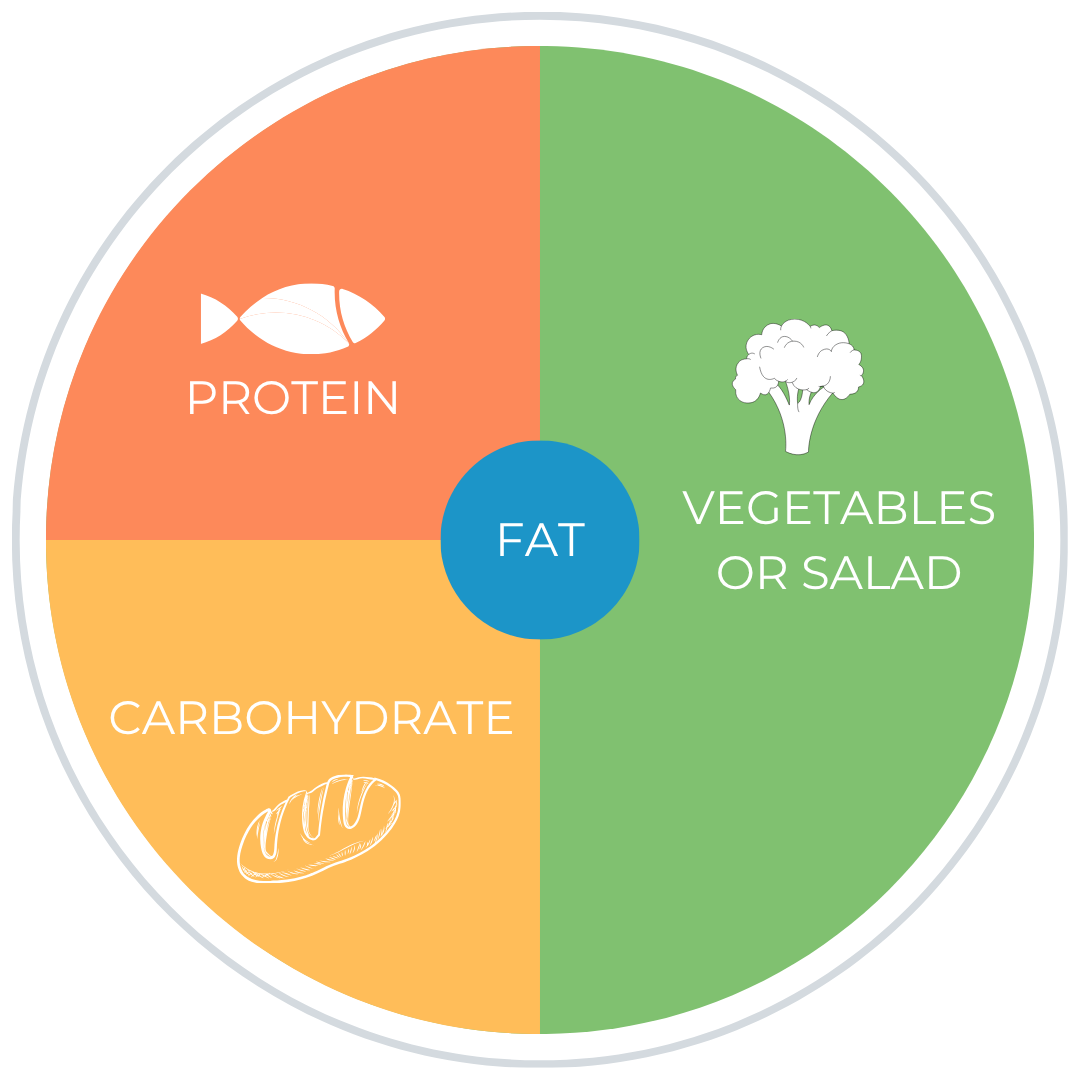
Healthy Balanced Meals…
A healthy, balanced meal consists of these four components. Remember to choose low GI or slowly broken down carbohydrates.