
When Calories In Calories Out Doesn't Work
Sarah came to me convinced something was fundamentally wrong with her body.
She'd been tracking her food meticulously for months. Twelve hundred calories a day, sometimes less. She knew her numbers. She was adamant she wasn't cheating, slipping or underestimating — and I believed her. She was doing exactly what she'd been told to do.
And it wasn't working.
"My metabolism must be broken," she said. "There's no other explanation."
She wasn't wrong that something was off. She just had the wrong explanation.
The calories in, calories out model is so deeply embedded in how we think about weight that questioning it can feel almost heretical. Eat less, move more — it's presented as simple physics, an irrefutable law of nature and if it isn't working, the implication is clear: you must be doing it wrong.
But the model has a significant blind spot.
It treats all calories as equal and the body as a passive system — a simple equation where less in always means less stored. What it doesn't account for is that the body isn't passive at all. It's constantly responding to hormonal signals that determine whether the food you eat gets burned for energy or stored as fat. And the most powerful of those signals is insulin.
When insulin levels are chronically elevated — as they are in insulin resistance — the body is effectively locked into fat storage mode. It doesn't matter how carefully you're counting. If insulin is high, fat burning is suppressed. The body is working against the goal, not toward it.
This is why Sarah wasn't losing weight on 1200 calories. It wasn't a lack of effort or a broken metabolism. It was that the hormonal environment in her body made fat burning genuinely difficult — regardless of how little she was eating.
In fact, very low calorie eating can make the situation worse over time. When you dramatically restrict food, the body reads it as a threat and responds accordingly — slowing metabolic rate, preserving fat stores and breaking down muscle instead. Muscle is metabolically active tissue, and losing it makes insulin resistance harder to shift, not easier.
What actually moves the needle isn't eating less. It's eating in a way that brings insulin levels down.
That means reducing the foods that spike blood sugar and insulin most rapidly and replacing them with foods that keep blood sugar steady: protein, fibre-rich vegetables, healthy fats, legumes and other low GI carbs. It means eating at regular intervals rather than grazing constantly, since every time you eat insulin rises. It means moving regularly since muscle has one of the greatest demands of glucose.
And it means letting go of the calorie equation — not because calories are irrelevant, but because focusing on them alone while ignoring the hormonal picture is like trying to fix a car by only checking the petrol gauge.
Sarah didn't need to eat less. She needed to eat differently — in a way that worked with her body's hormonal signals rather than against them.
Within a few months of shifting her approach, her weight began to move for the first time in years which was evidence that her metabolic environment had changed.
If this sounds familiar — if you've been eating carefully and still not seeing results — it might be worth looking at the full picture, not just the calories.
A good place to start is asking your doctor for a fasting insulin test. It's not done as a routine blood test, so you'll need to ask for it specifically — but any GP can order it. If you're an athlete struggling with weight, a glucose tolerance test with insulin levels measured at 0, 1 and 2 hours may give a clearer picture, since fasting insulin can appear normal even when the response to a meal is higher than it should be. And if you already have elevated blood sugars or an HbA1c above 5.6, that already indicates insulin resistance is likely.
I work with women on exactly this, combining nutritional support for insulin resistance with a deeper understanding of what's been driving eating behaviour. If you'd like to explore working together, you can find out about my clinics here or get in touch here.
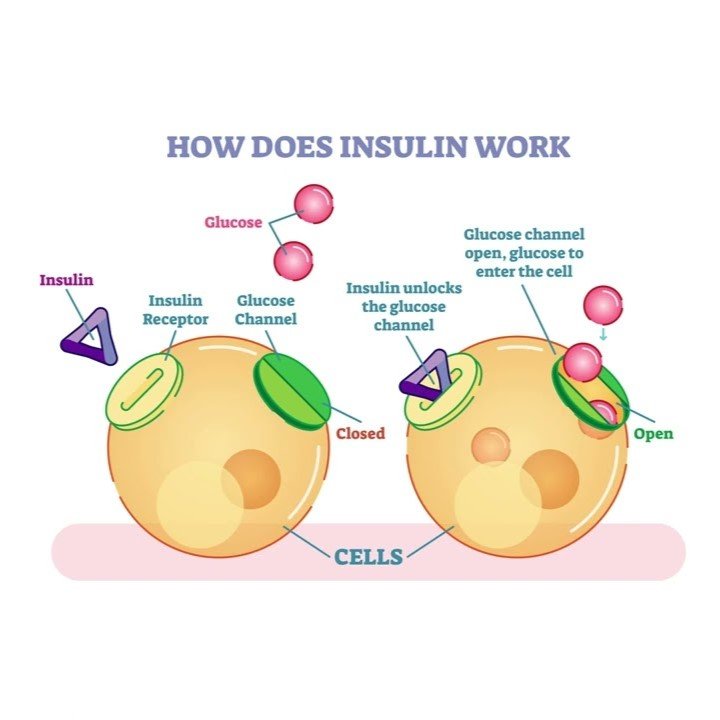
How insulin works…
It opens the glucose channel allowing glucose into the almost 50 trillion cells your body is made of. Pretty cool huh!